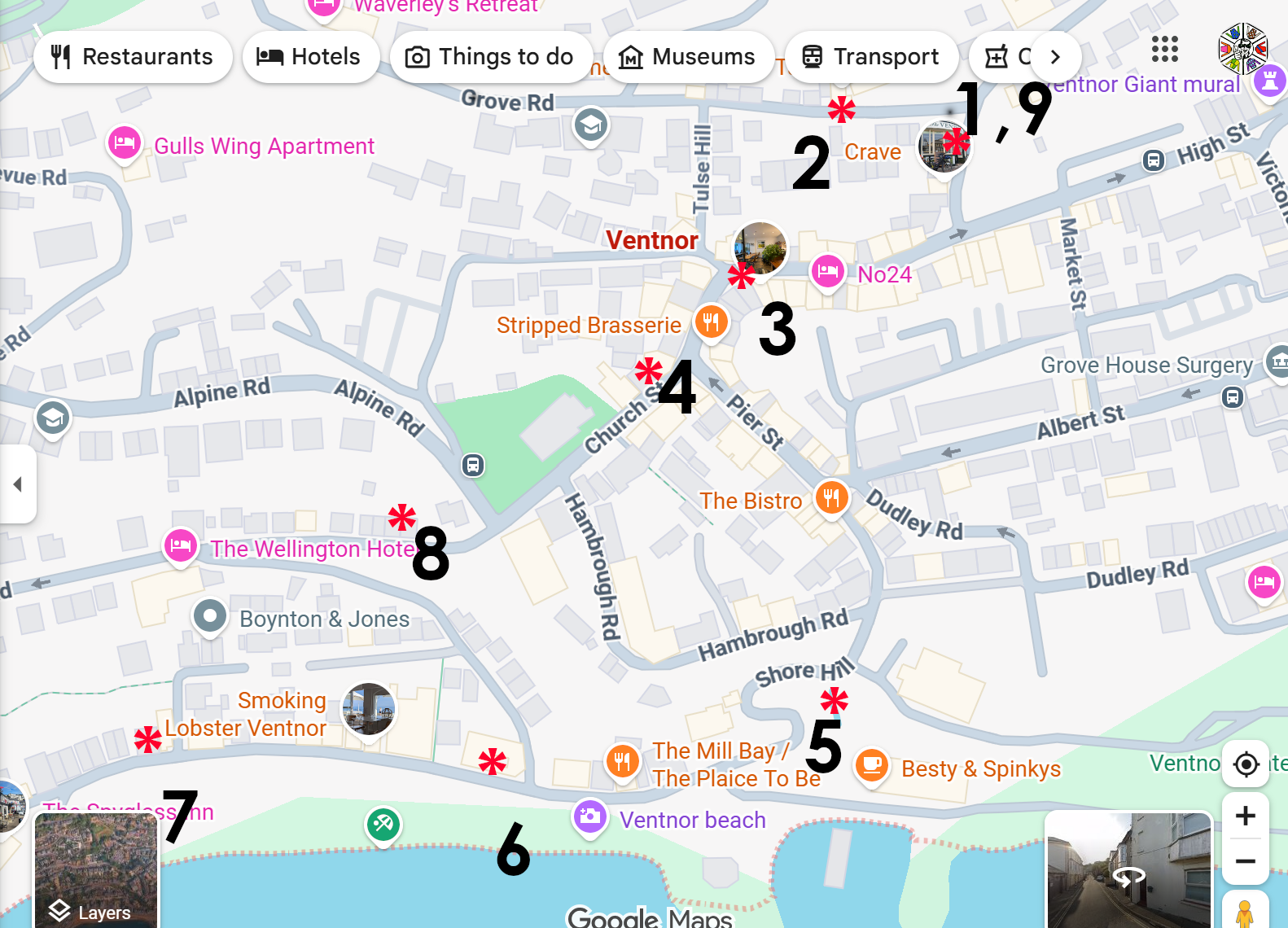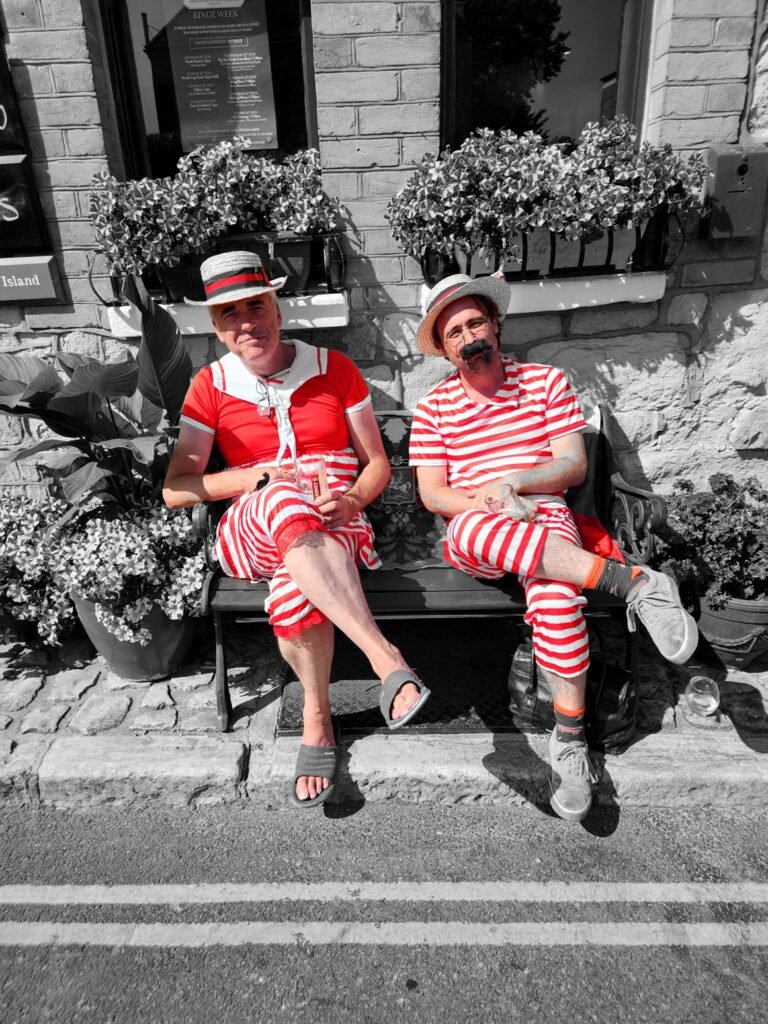
Following the staging of On Holiday With Herzen at the Ventnor Fringe, two fun, costumed history walks were undertaken on Saturday 25th July 2026. Here you can find the audio and text used for the walks and a map to allow you to undertake a self guided walk at your leisure.
With thanks to Stephan Roman and Richard Freeborn for the background. All errors are Bob Prophette’s.
STOP ONE – HERITAGE MUSEUM
STOP 2 – GROVE ROAD/CRAB AND LOBSTER
STOP 3 – HIGH STREET
STOP 4 – CHURCH STREET
STOP 5 – ST AUGUSTINE VILLA
STOP 6 – ESPLANADE
STOP 7 – ALMA ROAD
STOP 8 – BELGRAVE ROAD/ROCK COTTAGE
STOP 9 – RETURN TO THE HERITAGE MUSEUM
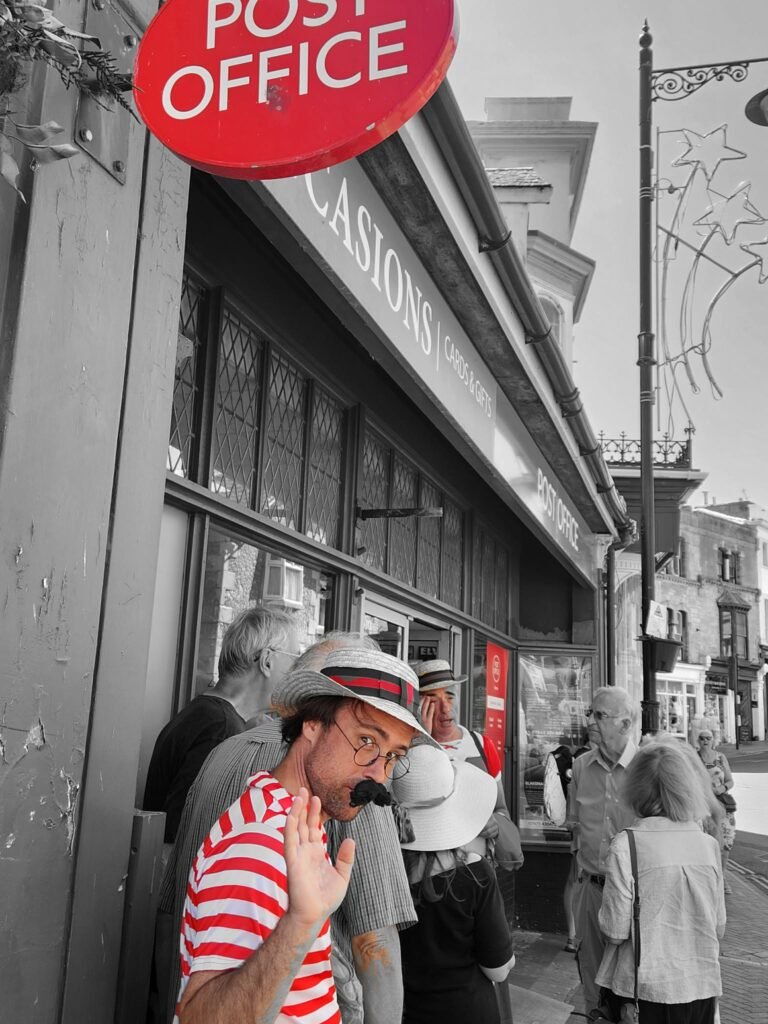
Stop 1 – Heritage Museum
Before we start walking round Ventnor, we need to take a short detour through modern Russian history — not too long, don’t worry, no one will be exiled to Siberia unless they ask a very difficult question.
The story begins in 1812. Russia helps defeat Napoleon. Russian officers march into Europe as liberators. They see constitutions, public debate, civic life — the idea that a country might belong to more than its ruler. Then they go home. And home is still autocracy, censorship, serfdom and obedience. Russia has saved Europe from a dictator, and the soldiers have returned to one.
In 1825, some of those officers try to change that. The Decembrists gather in Senate Square in St Petersburg and demand a constitution. It is Russia’s first revolution — if by revolution we mean brave, doomed, badly organised, aristocratic, and over by cannon-fire.
One of the men caught up in that movement was Nikolai Turgenev — not Ivan Turgenev, our Ventnor novelist, but an older relative. He was abroad at the time, but the Russian state tried him anyway and sentenced him in absence to lifelong penal servitude. So the name Turgenev already carries a revolutionary echo before Ivan ever arrives here to invent Bazarov.
Two boys heard that echo very clearly: Alexander Herzen and Nikolay Ogarev. As teenagers, they climbed Sparrow Hills above Moscow and swore to continue the Decembrists’ cause. It is one of those ridiculous, magnificent adolescent moments without which history would be much poorer: two boys, a view over Moscow, and a promise to fight autocracy.
Thirty years later, that promise washed up here, in Ventnor — with sea air, bathing machines, rented villas, bad weather, and a surprising number of Russians trying to imagine what their country might become.
Russian history in the nineteenth century is one long argument between fathers and sons — except the fathers have secret police, and the sons have pamphlets.
But revolutions have their own family problem. The young become old very quickly. Herzen and Ogarev had once been the sons: two boys on Sparrow Hills swearing to continue the work of the Decembrists. But by the late 1850s they were becoming the fathers. They had their journal, Kolokol — The Bell — ringing from exile. They had moral authority. They had history behind them.
Then came the sons.
In 1859, Nikolai Chernyshevsky came to London and met Herzen. We should not imagine a neat passing of the torch. It was more awkward than that. Chernyshevsky belonged to the new radical generation around The Contemporary: sharper, more impatient, more materialist, less romantic, less forgiving. Herzen had spent his life fighting autocracy, but to these younger men he could already look like an old liberal — humane, eloquent, European, compromised by nuance. The father of Russian socialism was discovering the terrible fate of fathers: the children had arrived, and they were not grateful.
So when Turgenev comes to Ventnor in 1860 and begins to imagine Bazarov, he is not inventing generational conflict from thin air. It is already in the air. Herzen feels it. Ogarev feels it. Turgenev feels it. The old radicals are being judged by the young radicals — and found wanting.
The argument of Fathers and Sons was already happening before Turgenev wrote it. It was happening in journals, in letters, in London meetings, in exile circles, and then — wonderfully for us — in Ventnor guest houses.
Every revolution begins by rebelling against its fathers. Then, if it lives long enough, it has the unpleasant experience of becoming one.
Stop 2 – Grove Road
We start here because this is where the Russian colony becomes visible, comic, crowded and socially tense. Imagine Grove Road in August 1860. A liberal here, a suspected ‘unreliable’ person aka spy there, a former censor over the road, a colonel connected to the emancipation of the serfs, families from Moscow and St Petersburg, everyone walking, bathing, calling, dining, translating, judging one another. Ventnor has become Russia — but with guest houses.
Rostovtsev: reformer. Kruze: a censor who didn’t censor anything. Krivochapkine: possibly harmless, which is exactly what a spy would want you to think. Annenkov: uncomfortable. Herzen: not here, because by now there were far too many Russians. By 1860 Herzen avoided Ventnor because it was overrun by Russians and went to Bournemouth instead.
Background
Stephan Romanov says Grove Road was almost becoming the “Russky Prospekt” of Ventnor because so many Russians were living there. Freeborn’s Ventnor Times trawl gives the addresses: Rostovtsev at Somerset Cottage, Kruze at 1 Primrose Bank, Krivochapkine at Prospect House.
Characters:
Colonel Nikolai Rostovtsev was a liberal sympathiser and son of Yakov Rostovtsev, involved in the reform process that led to emancipation of the serfs in 1861. He links Ventnor directly to the great question of the age: would Russia reform peacefully from above, or explode from below?
Leon Krivochapkine was an admirer of Herzen, but not entirely trusted by Annenkov and others. Romanov is careful: there is no evidence he was a police informer, but Annenkov was suspicious and uncomfortable around him.
Nicholas Kruze. He was a liberal and social activist who had also been a government censor — and was apparently dismissed because he was reluctant to censor. Herzen did not think much of him and nicknamed him “Robinson Kruse,” a man marooned on an island of his own liberal incompetence.
Stop 3 – High Street / Vale Cottage / Rose Cottage area
Here the Russian network becomes operational: letters, printing, secret contacts, suspicion.
This is where Ventnor becomes less a resort and more a switchboard. Letters arrive. Addresses are exchanged. People know people who know Herzen. Everyone is taking the air, but some of them are also taking precautions.
Herzen could diagnose the moral collapse of autocracy from several countries away. His grasp of Hampshire and the Isle of Wight was less secure.
Background
Kasatkin was not just another holidaying Russian. He was linked to Herzen’s Free Russian Press and later to the first Land and Freedom movement. Freeborn notes he became an active member of the first Zemlya i volya, was implicated in the “Affair of the 32,” and was sentenced in absence to exile for life. That gives the High Street a delicious doubleness: respectable seaside lodging outside; revolutionary communications inside.
Affair of the 32 was an incident in which a letter from Herzen to Turgenev was intercepted by the secret police. It as for funds to help Mikail Bakunin. As a result Turgenev was tried with 32 other suspects for subversive activities and had his passport suspended. Leaving in exile.
The Free Russian Press background: Herzen had founded the Free Russian Press in London in 1853. Its publications — including The Polar Star and later Kolokol, The Bell — were banned in Russia but smuggled in and read by reformers, officials, radicals and the merely curious. The joke here is that Russia’s uncensored political future was being discussed not in a barricaded cellar, but through London émigré channels and seaside villas.
Herzen’s terrible geography: Freeborn gives us a comic detail. Herzen’s sketch-map of the Isle of Wight and Bournemouth was wildly unhelpful: he placed things more or less where they were not. Turgenev and Annenkov later tried to visit Herzen at “Eagle’s Nest” near Bournemouth and got lost.
Stop 4 – Church Street / Woolton Cottage / Burnhill Cottage
Minor names, major atmosphere.
Some historical walks are about monuments. This one is about guest lists. The Ventnor Times becomes our police file, social diary and comic opera programme all at once.
Background
Ventnor is full of people who are famous, half-famous, later-famous, suspicious, misremembered, mistranscribed, and sometimes only visible because a local newspaper wrote down their names badly.
Romanov places Nikolai and Dmitri Goubarev at Woolton Cottage in Church Street – author of Socialism of our Age.
Mr Korsakov at Burnhill Cottage, possibly the radical A. S. Korsakov, Russian psychiatrist who argued for the banning of restraints in
later known for conspiracies against the Tsar. Freeborn also lists the Goubareffs at Woolton Cottage and Karsakoff at Burnhill Cottage.
Stop 5 -St Augustine’s Villa
Herzen and Malwida: exile becomes domestic, comic, political and seaside.
Herzen arrives here not as a marble bust, not as ‘the father of Russian socialism,’ but as a widower with children, luggage, grief, opinions, and Malwida von Meysenbug — which is to say, with someone in the party quite prepared to tell him when the scenery was better than he had admitted.
By day: sea air, bathing machines, children, cliff walks. By night: the Crimean War, the fall of autocracy, and the future of Russia. Ventnor was not an escape from politics. It was politics with better light.
Background:
Herzen first came to Ventnor in September 1854, already seven years into exile, after Italy, France and Switzerland. His wife Natalya had died in 1852; Malwida von Meysenbug had become part of the household — governess, surrogate mother, friend, companion, and a figure whose exact emotional role is difficult to reduce to one English word.
The arrival itself is lovely. Malwida describes the journey across the Island: Herzen and his son up top on the stagecoach, the children and Malwida inside, with Malwida calling up that the road was beautiful. Herzen, laughing, admitted she was right. This is humanising: the father of Russian socialism, on a stagecoach, being corrected about scenery by a formidable German woman.
The family spent days swimming or walking, and Malwida seems to have been a bathing enthusiast. Herzen was amused by her repeated expeditions into the bathing machines.
The evenings were spent with the Kossuths and Pulszkys, Hungarian exiles from the failed 1848 revolution. Russia had helped crush that uprising; now Britain and Russia were fighting in the Crimea. Herzen hoped Russian defeat might bring down autocracy. So, while Ventnor sold itself as a place of healing, the conversations here were about war, empire, censorship, serfdom and whether disaster might open the door to reform.
Stop 5 – Esplanade Hotel / aristocratic radicals
This stop complicates the easy “radical vs aristocrat” picture.
One of the traps in telling this story is to imagine radicals as shabby men in cellars. In Ventnor, radicalism may arrive with luggage, servants, visiting cards, and very good manners.
Background:
Freeborn lists Prince Victor and Princess Bariatinsky, and Countess Chreptonwitch, at the Esplanade Hotel. Romanov adds that Princess Maria Bariatinsky later became close to Turgenev and was known in liberal circles for combining charm with political radicalism.
The Russian story is not “poor revolutionaries against rich aristocrats.” Many of these people are aristocratic, well-connected, multilingual, fashionable, and politically dangerous in drawing rooms rather than basements.
Stop 6 – Esplanade / Alma Road
Here we have Bazarov by the sea; the literary climax.
Here, or very near here, Turgenev is close to the sea, close to Annenkov, close to the Russian colony, and close to the thing he does not yet know how to name. Later it will be called nihilism. In Ventnor, it is still weather, conversation, irritation, observation — a young doctor glimpsed elsewhere, but understood here.
This is not the Mediterranean of revolution. This is bottle-green water, damp sand, English backs held very straight, and Russians trying to decide whether history is about to improve or become much worse.
The plaque remembers the great literary fact. But the comic fact is almost as good: the novelist may have got here because Annenkov smoked.
Background:
The Ventnor Times confirms the move: on 18 August, “Mr Tourguenett” was at Rock Cottage, Belgrave Road; by 25 August, Ivan Tourguenoff and Pavel Annenkoff were at Belinda House, Esplanade, and Turgenev was still there on 1 September. Belinda House no longer exists; Freeborn says it became unsafe through earth movement and its place was later taken by Cedar Lodge.
This is where the two creations of Ventnor 1860 come together: The first idea for Fathers and Sons. The second is the educational/literacy society plan, which Freeborn links to the revolutionary and propagandist culture around Ogarev and the first Land and Freedom.
Turgenev’s description of the shore is not sentimental: yellow-brown sand, cold bottle-green waves, straight-backed English figures walking on the damp sand. That is a useful contrast with the tourist postcard.
Stop 7 – Belgrave Road / Rock Cottage
Turgenev arrives; the novel begins; comedy turns into literary history.
This is the stop where world literature enters in a wet coat. Turgenev comes to Ventnor for sea-bathing and company, and leaves with the germ of Bazarov — the nihilist who will alarm almost everyone, including his creator.
There are many theories of literary creation. Genius. History. Psychological conflict. Here we should add: rain.
The great move from Belgrave Road to the Esplanade may not have been caused by ideology, police surveillance or a quarrel over the future of Russia. It may have been caused by cigarettes.
Background:
Freeborn says Turgenev arrived in Ventnor on 12 August 1860 after travelling via Portsmouth, and the next day took rooms in Rock Cottage, Belgrave Road. He was there for sea-bathing, for Annenkov, for Marko Vovchok, and because a congenial Russian colony was expected.
Turgenev spent three weeks in Ventnor and later said he had the first idea for Fathers and Children — usually translated now as Fathers and Sons — while taking sea baths here. Freeborn also notes that he drafted a programme for a “Society for the Propagation of Literacy and Primary Education” during this stay.
Weather: Turgenev first raved about the island: trees, flowers, cliffs, hay, sea — luxury. Then the weather turned. He complained of storms, could not bathe, and Freeborn dryly suggests that English summer weather may be considered the principal cause of Turgenev’s masterpiece.
Smoking friend: Annenkov arrived; the landlady objected to his cigarette-smoking; she was a Nonconformist; Turgenev refused to bow to “the caprice of a nonconformist” and found new lodgings down by the bathing place.
Stop 8 – Return to Heritage Museum
What happened in Ventnor was not a revolution. No barricade was built here. No Tsar was killed here. No manifesto was nailed to a bathing machine. But something did happen. People met safely. They argued. They read. They carried letters. They imagined another Russia. And Turgenev, watching them, listening to them, and perhaps being irritated by them, found the figure who would make the old world tremble on the page: Bazarov.
So when we say On Holiday with Herzen, the joke is not that politics has gone on holiday. The joke is that politics follows you — even to Ventnor, even to the Esplanade, even into the rain.